One For All Remote User Guide ─ Comprehensive Overview (April 21, 2026)
Welcome! This guide details setup, programming, and troubleshooting for your One For All remote (URC-7210, URC7945, URC7510), ensuring seamless device control.
One For All remotes represent a significant advancement in home entertainment control, offering a streamlined solution to manage multiple devices. These universal remotes, like the URC-7210, URC7945, and URC7510 models, eliminate the clutter of numerous individual remote controls. They are designed for ease of use, catering to a broad range of users regardless of their technical expertise.
This guide focuses on maximizing your One For All remote’s potential. We’ll cover everything from initial setup – including battery installation and understanding the keypad layout – to advanced programming techniques. Accessing the correct device codes, found within the provided manual or online resources, is crucial for successful operation. The goal is to simplify your entertainment experience, providing effortless control over your TV, audio systems, and other connected devices.
What is a Universal Remote and its Benefits?
A universal remote, such as those offered by One For All, is a single device programmed to operate multiple electronic components. Unlike manufacturer-specific remotes, a universal remote consolidates control of your TV, DVD player, sound system, and streaming devices into one convenient unit. This eliminates the need for juggling several remotes, reducing clutter and simplifying your entertainment setup.
The benefits are numerous: increased convenience, reduced clutter, and cost savings. One For All remotes offer features like code searching and manual code entry, ensuring compatibility with a vast array of brands. They represent a technological change in home entertainment, offering a user-friendly alternative to traditional remote control systems. Ultimately, a universal remote enhances your viewing experience.

Setting Up Your One For All Remote
Begin with the basics! Install batteries, familiarize yourself with the keypad layout, and power on your One For All remote for initial operation.
Installing Batteries
Powering up is simple! Locate the battery compartment, typically on the back or bottom of the remote. Slide open the compartment cover, observing the polarity markings (+ and -) inside. Insert the required batteries – usually AAA or AA – ensuring correct alignment.
Important notes: Always use fresh batteries for optimal performance. Mixing old and new batteries, or different battery types, is not recommended. If the remote doesn’t power on after installation, double-check the battery polarity and ensure they are securely in place. A weak battery signal can cause erratic behavior or limited functionality. Replace batteries promptly when indicated.
Understanding the Keypad Layout
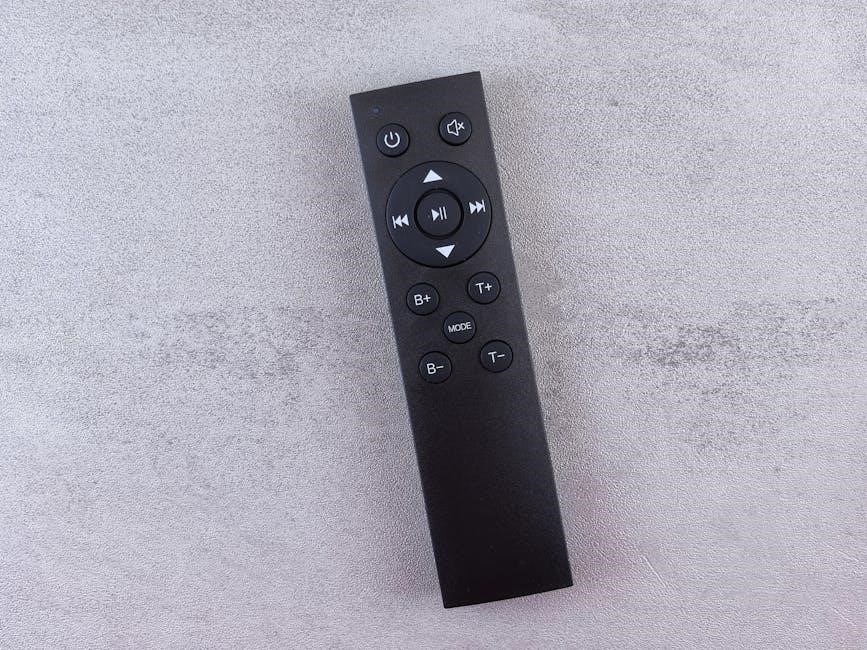
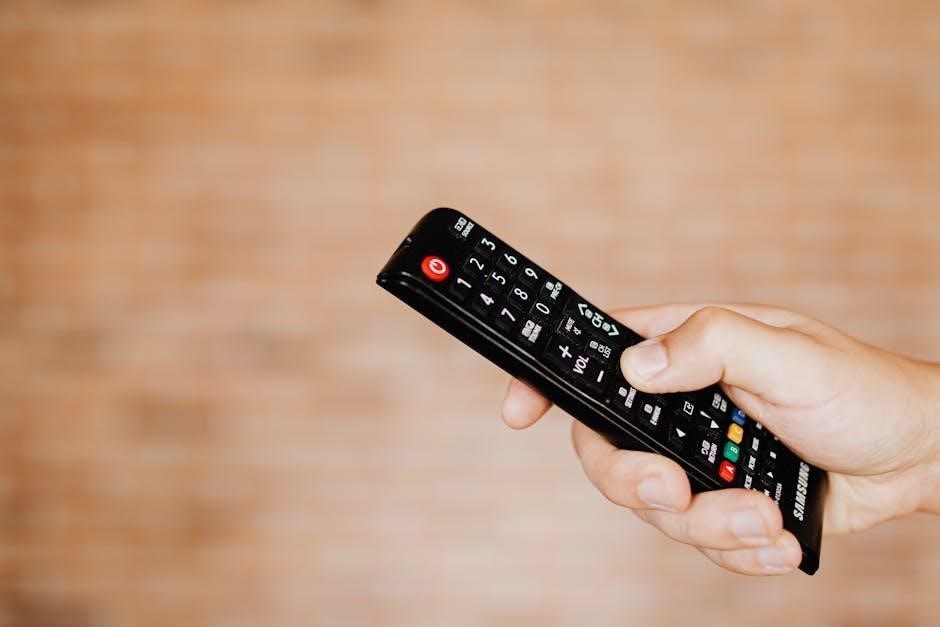
Familiarize yourself with the controls! The One For All remote features a numeric keypad for direct code entry, essential for manual programming. Dedicated buttons control power, volume, channel selection, and input source. You’ll also find navigation buttons (up, down, left, right) and an ‘OK’ or ‘Select’ button for menu confirmation.
Specialized buttons may include ‘Menu’, ‘Info’, ‘Guide’, and dedicated streaming service shortcuts. The ‘Mute’ and ‘Play/Pause’ buttons offer quick access to common functions. Understanding the layout streamlines setup and daily operation. Refer to the diagram in your user manual for a visual guide to each button’s function, maximizing your remote’s potential.
Initial Setup and Powering On
Let’s get started! Begin by installing the batteries (refer to the dedicated section for detailed instructions). Once batteries are correctly inserted, the remote should power on instantly. If it doesn’t, double-check battery polarity. The remote typically doesn’t have a dedicated ‘Power’ button for itself; it activates when a function button is pressed.

Initial operation involves programming the remote to control your devices. Before programming, ensure your target device (TV, audio system, etc.) is powered on. The remote will then communicate with the device during the code entry or search process. A steady light indicates successful transmission; consult troubleshooting if signals aren’t sent.
Programming Your Remote
Effortless control awaits! Program your One For All remote using automatic code search or manual code entry, referencing the provided code list for compatibility.
Automatic Code Search Method
Simplifying setup, the automatic code search method streamlines programming your One For All remote. Begin by powering on the device you wish to control – your TV, for instance – and ensure it’s in standby mode. Then, press and hold the ‘Setup’ or ‘Magic’ button on your remote until the indicator light illuminates.
Next, enter the device type code (TV, DVD, etc.) using the numeric keypad. The remote will then automatically transmit a series of codes to your device. Watch closely! When your device responds – meaning it turns off or changes volume – immediately press the ‘OK’ or ‘Enter’ button to lock in the code.
If the first code doesn’t work, the remote will continue cycling through codes. Repeat the process until successful. This method eliminates the need to manually search through extensive code lists, offering a quicker programming experience.
Manual Code Entry Method
For precise control, the manual code entry method allows direct programming using codes from the provided code list. First, power on the device you intend to control and ensure it’s in standby. Press and hold the ‘Setup’ or ‘Magic’ button on your One For All remote until the indicator light activates, signaling setup mode.
Next, input the corresponding device type code (e.g., ‘001’ for TV) using the numeric keypad. Following this, carefully enter the 3-digit code specific to your device’s brand, as found within the code list included with your remote.
After entering the code, release the ‘Setup’ button. The remote will attempt to communicate with your device. If successful, the device will respond – typically by turning off. If it doesn’t work, repeat the process with a different code from the list.
Using the Code List (Locating Codes)
The code list is crucial for manual programming. It’s typically included with your One For All remote, or available for download as a PDF. Codes are organized by device type – TV, DVD, Audio, and more – and then alphabetically by brand name.
Locate your device’s manufacturer in the list. Several codes may be listed per brand; it’s recommended to try them sequentially. Begin with the first code provided for your brand and proceed through the list if the initial attempt fails.
Remember to note the device type code (e.g., ‘001’ for TV) needed before entering the brand-specific 3-digit code during the manual programming process. Online resources and support can also assist in locating the correct code if the printed list is unavailable.

Device Compatibility & Codes
Extensive compatibility is a key feature, offering codes for popular brands like Samsung, Sony, LG, and many others, across TVs and audio devices.
TV Codes – Popular Brands
Finding the correct code for your television is crucial for successful operation. One For All remotes support a vast library of codes for leading TV manufacturers. For Samsung TVs, commonly used codes include 0060, 0030, and 0019. Sony TV users often find success with codes like 0020, 0016, or 0017. LG televisions frequently respond to codes 0050, 0062, and 0033.
Vizio owners should try 0178, 0004, or 0105. Remember to consult the complete code list included with your remote or available for download online. If the first code doesn’t work, systematically try others until you find one that controls your TV’s power, volume, and channel functions. Accurate code entry ensures optimal performance and a user-friendly experience.
Audio Device Codes – Receivers & Soundbars
Programming your One For All remote to control audio devices like receivers and soundbars expands its functionality. For Sony audio receivers, try codes 0010, 0019, or 0026. Samsung soundbar users often find compatibility with codes 0030, 0060, and 0020. Yamaha receivers frequently respond to codes 0040, 0037, or 0017.
Bose sound systems may work with codes 0045, 0015, or 0023. Remember to test each code by attempting to adjust the volume. If none of these codes work, refer to the comprehensive code list provided with your remote or accessible online. Successful code entry allows seamless control of your audio experience, enhancing your home entertainment setup.
Auxiliary Device Codes – DVD Players, Streaming Devices
Expanding control beyond TVs and audio, your One For All remote can manage DVD players and streaming devices. For Samsung DVD players, codes like 0035, 0036, or 0037 are frequently effective. LG DVD players often respond to codes 0041, 0042, or 0043. When programming for Roku streaming sticks, try codes 0176, 0177, or 0178.
Apple TV users may find success with codes 0065, 0066, or 0067. Remember to consult the full code list included with your remote for the most accurate and up-to-date options; Testing each code after entry is crucial to confirm functionality and enjoy complete control over all your entertainment sources.
Troubleshooting Common Issues
Facing problems? This section addresses unresponsive remotes, incorrect code entries, and devices not being recognized – solutions for a smooth experience.
Remote Not Responding
Is your One For All remote failing to power on or control devices? First, ensure fresh batteries are correctly installed, verifying polarity. If the issue persists, try resetting the remote – consult your specific model’s manual for reset procedures. Sometimes, interference from other electronic devices can cause problems; move away from potential sources.
Check for physical obstructions blocking the IR sensor on both the remote and the target device. A weak signal can also occur if the remote is used at an extreme angle. Finally, confirm the device itself is powered on and functioning correctly. If none of these steps resolve the issue, further troubleshooting or contacting customer support may be necessary.
Incorrect Code Entered
Experiencing issues where your remote isn’t responding correctly after code entry? This commonly happens when the initially entered code doesn’t perfectly match your device’s manufacturer or model. Don’t worry, it’s easily resolved! Re-consult the code list within your user manual – carefully verify you’ve selected the correct code for your specific brand and device type.
If the first code doesn’t work, systematically try several alternative codes listed for your device. Remember, multiple codes may be available. The automatic code search method is also a viable option if manual entry proves unsuccessful. Patience is key; finding the right code ensures full functionality.
Device Not Recognized
Is your One For All remote failing to control a device even after entering what you believe is the correct code? Several factors could be at play. First, ensure the device is powered on and within the remote’s line of sight. Check the batteries in both the remote and the target device – low power can cause communication failures.
If issues persist, the device might not be included in the remote’s current code database. Consider utilizing the learning function (if supported by your remote model) to teach the remote your device’s signals. Alternatively, explore online support resources or contact customer support for assistance with potentially unavailable codes.
Advanced Features & Settings
Unlock greater control! Explore macro programming and the learning function (if available on your model) for customized, efficient device operation and expanded compatibility.
Macro Programming (If Supported)
Automate complex sequences with macros! If your One For All remote supports macro programming, you can combine multiple commands into a single button press. This feature streamlines operations like powering on several devices simultaneously – your TV, receiver, and streaming device – with just one touch.
To create a macro, you’ll typically enter a macro recording mode, then input each desired command individually, pausing briefly between each. Once finished, save the macro to a specific button. Remember to consult your remote’s specific user manual (available as a PDF download) for detailed, model-specific instructions. Macro functionality significantly enhances convenience, reducing the need for multiple remote actions.
Learning Functionality (If Supported)
Expand compatibility with the learning function! Some One For All remotes offer a learning capability, allowing them to mimic commands from your existing remotes. This is invaluable for devices lacking dedicated codes in the remote’s database. To utilize this feature, you’ll enter a learning mode, then point your original remote at the One For All remote.
Press the button on the original remote corresponding to the desired function, and then press a button on the One For All remote to store that command. Repeat this process for each function you wish to learn. Detailed instructions, specific to your remote model, are available in the downloadable PDF user manual. Learning functionality provides ultimate flexibility and control.
Resources & Support
Need assistance? Download manuals, explore FAQs, or contact our customer support team for help with your One For All remote setup and usage.
Downloading User Manuals (PDF)
Accessing comprehensive documentation is easy! One For All provides downloadable PDF user manuals for all remote control models, including the URC-7210, URC7945, and URC7510. These manuals offer detailed instructions on initial setup, programming procedures (automatic and manual code entry), and explanations of advanced features.
You can find these resources through a dedicated manuals search engine, ensuring you locate the correct document for your specific remote. The PDFs contain valuable information, including code lists for various TV, audio, and auxiliary devices. Downloading the manual allows offline access to troubleshooting tips and a complete overview of your remote’s capabilities. These resources are readily available for convenient support.
Online Support & FAQs
Need quick answers? One For All offers extensive online support resources, including a frequently asked questions (FAQs) section addressing common setup and programming challenges. This online hub provides solutions for issues like remote not responding, incorrect code entry, and device recognition problems.
The website features troubleshooting guides and helpful articles designed to empower users to resolve issues independently. Accessing these resources is often faster than contacting customer support. The online platform is continuously updated with new information and solutions based on user feedback. Explore the support section for detailed guides and step-by-step instructions to maximize your remote’s functionality.
Contacting Customer Support
For personalized assistance, One For All provides dedicated customer support channels. While the online FAQs and manuals cover many issues, direct support is available for complex problems or unique situations. Contact options may include phone support, email submission, or live chat features, depending on your region and the specific remote model.
Before contacting support, have your remote’s model number (URC-7210, URC7945, URC7510) readily available, along with details about the devices you’re trying to control. This information will help the support team diagnose and resolve your issue efficiently. Check the official One For All website for the most up-to-date contact information and support hours.